Walking Through Venice
Venice is located in the Veneto region of northeastern Italy. Although the municipality of Venice also includes parts of mainland Italy, when you think of Venice, you probably picture the “City of Water”, where gondolas sail along the canals.
This island area is known as the Historic Center of Venice and, together with 118 surrounding islands, forms the World Heritage Site “Venice and its Lagoon”1).
People began settling in this area around the 5th century1). At the time, in northern Italy, repeated invasions by foreign peoples forced mainland inhabitants to seek refuge in the shallow waters and wetlands of the lagoon. What began as a temporary refuge gradually became a permanent settlement. People drove numerous wooden piles into the ground, laid stone on top to create foundations, and built the city over many years2).
Venice is unique not only for its foundations, but also for its streetscapes. The canals are probably the first thing that comes to mind, but there are only two major canals: the Canal Grande and the Canale della Giudecca. Most of the other waterways are called rii (rio). More than 400 bridges cross these canals and waterways, while around 3,000 small streets form a maze-like city3).
The names used for streets are another distinctive feature of Venice. Elsewhere in Italy, streets are commonly called vie (via), but in Venice’s historic center, there is only one street with this name: Via Garibaldi. The other streets have a variety of names, including the following:
- Calle: A narrow street lined with buildings on both sides
- Ramo: A short lane branching off a main street
- Salizada: A relatively wide street paved with stone
- Sottoportego: A passageway running beneath a building
- Fondamenta: A walkway running alongside a canal or waterway (sometimes featuring railings or low stone parapets)
- Riva: A street running along the edge of a relatively wide stretch of water (also used for mooring boats and handling cargo)
- Rio terà: A street created by filling in a former canal
In Venice, a city built on water, cars and bicycles are not permitted in the historic center, so people get around on foot or by boat. In the past, wealthy families sometimes owned gondolas for private use, but today they are used almost exclusively for tourism. Visitors can also take the vaporetto (water bus), but these boats are often crowded, so I recommend exploring the city on foot. Be sure to watch out for pickpockets, especially in busy areas.
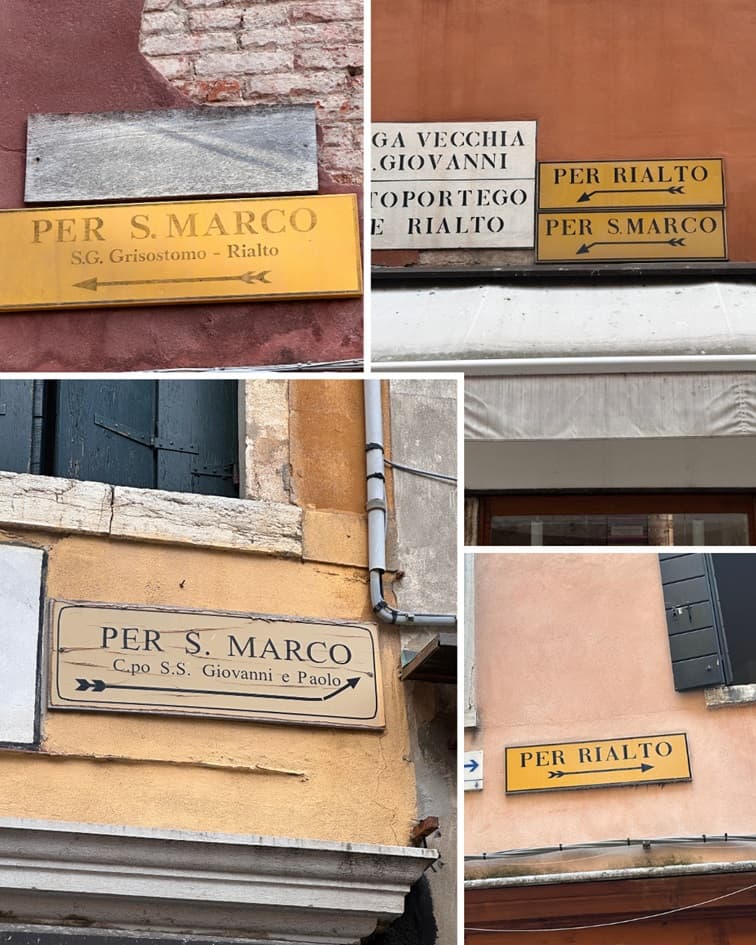
When visiting Venice, take time to explore not only the famous sights but also the lesser-known backstreets and alleyways. Don’t worry if you get lost. Just follow the signs reading “PER S. MARCO” or “PER RIALTO” throughout the city, and you’ll eventually find your way to Piazza San Marco or the Ponte di Rialto, two of the city’s central landmarks.
[References]
M. Lotter, The Magic of Beads: A Glass Bridge Between Murano and Kyoto, Ishinsha, Kyoto, 2025, 67–69 (Japanese-English bilingual edition).
1)Ministero della Cultura, “Venezia e la sua laguna”, Ministero della Cultura, Ufficio UNESCO, Accessed November 7, 2026, https://unesco.cultura.gov.it/projects/venezia/
2)unesco World Heritage Convention, “Venice and its Lagoon”, UNESCO World Heritage Centre, Accessed November 7, 2026, https://whc.unesco.org/en/documents/6436
3)Città di Venezia / Ve.La. S.p.A., “Il territorio di Venezia”, Venezia Unica, Accessed November 7, 2026, https://www.veneziaunica.it/it/cosa-fare-a-venezia/il-territorio-di-venezia