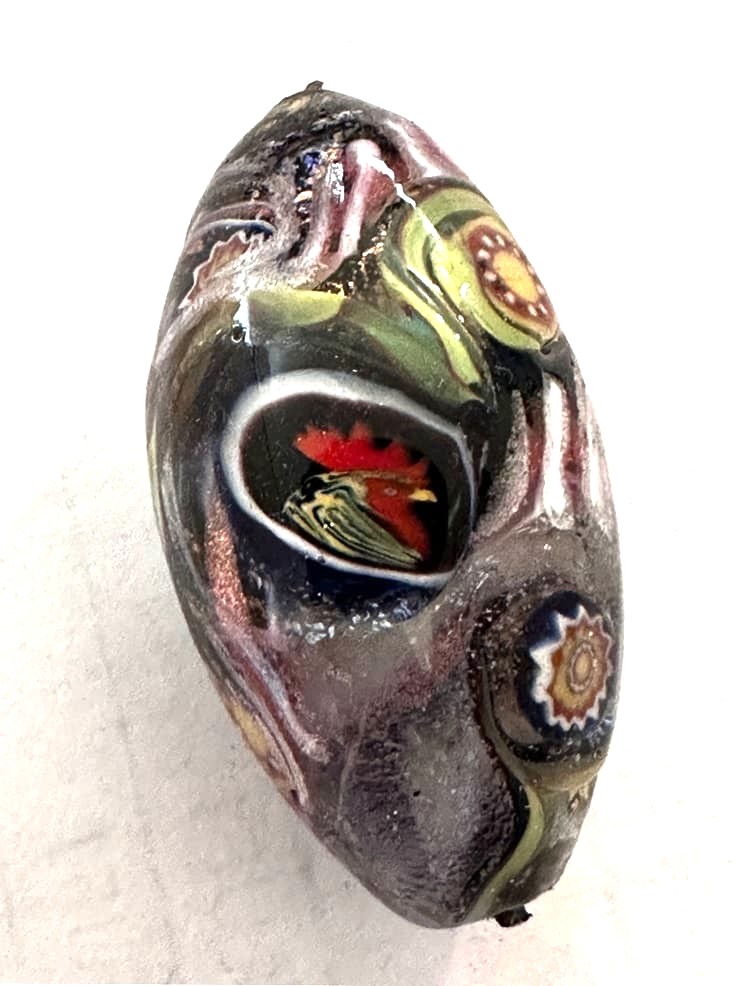
The Rooster Bearing the Pride of Murano
Glass is believed to have been first made more than 4,000 years ago1). It developed in regions such as Mesopotamia, Syria, and Egypt, and over time spread to Europe.
During the Roman period, vessels made of mosaic glass (murrino glass) were created by combining slices cut from glass rods (canes) of various colors2). The technique was revived by glassmakers on the island of Murano in the 19th century.
The glassmakers used glass canes, like traditional Japanese Kintarō-ame candy, incorporating various patterns such as flowers and stars, and slices cut from them (murrine), to create intricate and innovative works. Glass created by combining murrine to form vivid floral patterns came to be known as “millefiori (a thousand flowers),” and is now recognized as a representative glass craft of Murano.
One of the pioneers who opened up new possibilities for millefiori in the modern era was Giovanni Battista Franchini (1804–1873)3). He went beyond the traditional star-shaped patterns and created murrine with a wide variety of intricate designs4). His son, Giacomo (1827–1897), also produced murrine depicting portraits of contemporary heroes such as Vittorio Emanuele II and Garibaldi.
It is Vincenzo Moretti (1835–1901) who studied, analyzed, and reproduced the ancient techniques of murrino glass4). He created murrine using techniques from the Alexandrian and Roman periods, and these techniques were passed down to his son Luigi (1867–1946) and grandson Ulderico (1892–1956)5).
The period when Ulderico was active was a time of great change for the island of Murano. At the time, Venice and Murano were separate municipalities within the Kingdom of Italy, but a royal decree of December 30, 1923, determined that the municipality of Murano would be incorporated into that of Venice6).
Around this time, the Muranese staged protests against the annexation. They stamped the image of the “rooster,” a symbol of Murano, on walls throughout the island, continuing their vigorous protests7). Ulderico, too, expressed his protest by creating various murrine depicting roosters8). The Muranese are said to have worn rooster murrine as a symbol of their pride, as badges, earrings, and pendants.
Giusy Moretti, Ulderico’s adopted daughter and heir to the Moretti family legacy, inherited murrine passed down through the generations. She designs and creates one-of-a-kind jewelry using these murrine, carrying this legacy on to the next generation. The rooster murrine are among those she inherited.
I was entrusted by her with several precious rooster murrine, which I have brought back to life as glass beads. She has also shared my work on her Facebook9).
The rooster, bearing the history and pride of Murano, continues to raise its voice from within the glass. Creating works with glass that carries this history is both a great privilege and a great responsibility for me.
I would like to express my heartfelt gratitude to Giusy Moretti for entrusting me with these precious pieces of glass and giving me this opportunity.
Thank you, Giusy.
[References]
1)Museo del Vetro, “Le origini,” Museo del Vetro, Accessed October 2, 2026, https://museovetro.visitmuve.it/it/il-museo/percorsi-e-collezioni/raccolta-archeologica/.
2)V. Gedzevičiūtė, N. Welter, U. Schüssler, and C. Weiss, “Chemical composition and colouring agents of Roman mosaic and millefiori glass, studied by electron microprobe analysis and Raman microspectroscopy,” Archaeol Anthropol Sci 2009; 1: 15–29, https://doi.org/10.1007/s12520-009-0005-4.
3)A. Panini, Il mondo in una perla. La collezione del Museo del vetro di Murano, Antiga Edizioni, Crocetta del Montello (TV), 2017, 33–34.
4)G. Sarpellon, Murrine e perle veneziane, Fondazione Musei Civici di Venezia, Venezia, 2018.
5)G. Moretti, “La Storia della Famiglia Moretti,” Giusy Moretti® Luxury Design, Accessed October 2, 2026, https://www.giusymoretti.it/storia/.
6)Regno d’Italia, Gazzetta Ufficiale del Regno d’Italia, Parte Prima, 18 gennaio 1924; 15: 279, Accessed October 2, 2026, https://www.conaf.it/wp-content/uploads/2018/02/2-R.D.-del-31-dicembre-1923-n.-2909-G.U.-del-18-gennaio-1924-n.15_3.pdf.
7)A. Toso Fei and D. Marangon, I graffiti di Venezia, lineadacqua edizioni, Venezia, 2022, 195–197.
8)Museo del Vetro di Murano, Schegge di vetro 08_2012: Gioielli. Le murrine, Fondazione Musei Civici di Venezia, Venezia, 2012.
9)G. Moretti, Facebook, August 15, 2026, https://www.facebook.com/story.php?story_fbid=1017467421128489&id=100085957215057.